Cambodia’s Prey Long forest is “equivalent to life itself” for local communities

The largest area of intact lowland evergreen forests in southeast Asia is under threat.
Read more »

Wilful ignorance: FAO and industrial tree plantations

FAO continues to push the lie of “planted forests”.
Read more »

Bath tubs, forests, carbon trading and climate change

Why trading the carbon stored in forests will not help address runaway climate change.
Read more »

Plantations, poverty and power

Europe’s role in the expansion of the pulp industry in the South

A report by Chris Lang, published by World Rainforest Movement, December 2008
Read more »

Plantations, poverty and power: Introduction

Plantations, poverty and power: Section 1

Plantations, poverty and power: Section 2

Plantations, poverty and power: Section 3

Plantations, poverty and power: Section 4

Plantations, poverty and power: Section 5

Plantations, poverty and power: Europe’s role in the expansion of the pulp industry in the South

Announcing my new report: “Plantations, poverty and power: Europe’s role in the expansion of the pulp industry in the South”.
Read more »

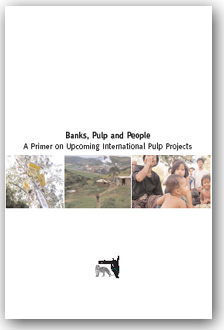
Taking the land, impoverishing the people: The pulp industry in the Mekong Region

Despite the social and environmental impacts of the pulp industry in the Mekong Region, governments, banks and consultants are helping it to expand.
Read more »

Vietnam: Paper shortages, price increases, new mills and more plantations

Vietnam has an ever increasing area of monoculture eucalyptus plantations. Nevertheless, the country faces paper shortages every year.
Read more »

The ADB is destroying the Mekong’s forests and the planet’s climate

Through funding coal-fired power plants, the Asian Development Bank is helping accelerate climate change. Its destruction of forests makes things worse.
Read more »

Dams on the Mekong mainstream would destroy fisheries for millions

Building dams on the Mekong mainstream will destroy the Mekong’s fisheries and subject millions of people to food shortages and poverty.
Read more »

Did FSC pass the practical test or is it on the wrong track?

By Chris Lang. Presentation at a conference in Berlin: “Sustainability certificates for agroenergy: Guardrail or lubricant for trade with regrowing energy resources?” organised by Brot für die Welt and FDCL, 4 October 2008.
Read more »

Why certification of agrofuels won’t work

The massive expansion of agrofuels is responsible for forest destruction, livelihood loss and increased food costs. Certification of agrofuels will do nothing to address the problems.
Read more »

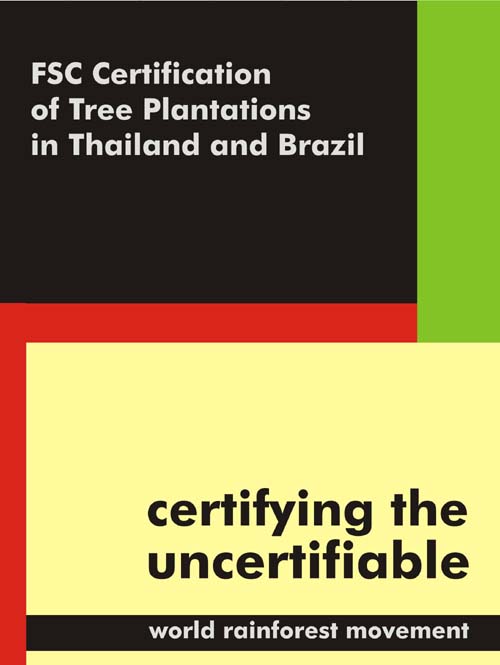
FSC: Stop certifying monoculture tree plantations!

FSC is undermining its own legitimacy and (more importantly) struggles in the South against monoculture tree plantations. The record is not good.
Read more »

Uganda: Thousands of Indigenous People evicted from FSC-certified Mount Elgon National Park

Why SGS must withdraw its certificate of Mount Elgon.
Read more »

The Confederation of European Paper Industries’ Looking-Glass World

CEPI’s grip on reality always was tenuous at best. Now it seems to have completely lost it.
Read more »

“Shrink”: A new campaign to stop the madness of paper over-consumption

South Africa: A visit to Komatiland Forests’ industrial tree monocultures

Despite being certified by the Forest Stewarship Council, Komatiland Forests’ industrial tree plantations are far from environmentally or socially responsible.
Read more »

FSC’s greenwash at the Convention on Biodiversity

Yesterday, FSC organised a side-event at the Ninth Conference of Parties to the Convention on Biodiversity in Bonn. Activists from Global Forests Coalition and World Rainforest Movement made their voices heard at the side event.
Read more »

Argentina: Scientists confirm that plantations dry up streams and salinise groundwater

A series of peer reviewed scientific papers confirms what local communities living near industrial tree plantations already know: industrial tree plantations suck water out of the soil and dry up streams.
Read more »

Bangladesh: Phulbari coal mine – “losses beyond compensation”

A UK company is planning to build a huge coal mine in Bangladesh. The impacts would be devastating. The Asian Development Bank is considering supporting the project anyway.
Read more »